
AP Calculus Exam Prep
2026 Spring
AP Calculus AB Exam Prep
Online
Instructor: Oksuz
Sunday 1:30 – 3:30PM CST
Dates: Feb 8 to March 29
No Class Date: NA
Fee: $549
AP Calculus BC Exam Prep
Online
Instructor: Oksuz
Sunday 1:30 – 3:30PM CST
Dates: Feb 8 to April 26
No Class Date: NA
Fee: $799
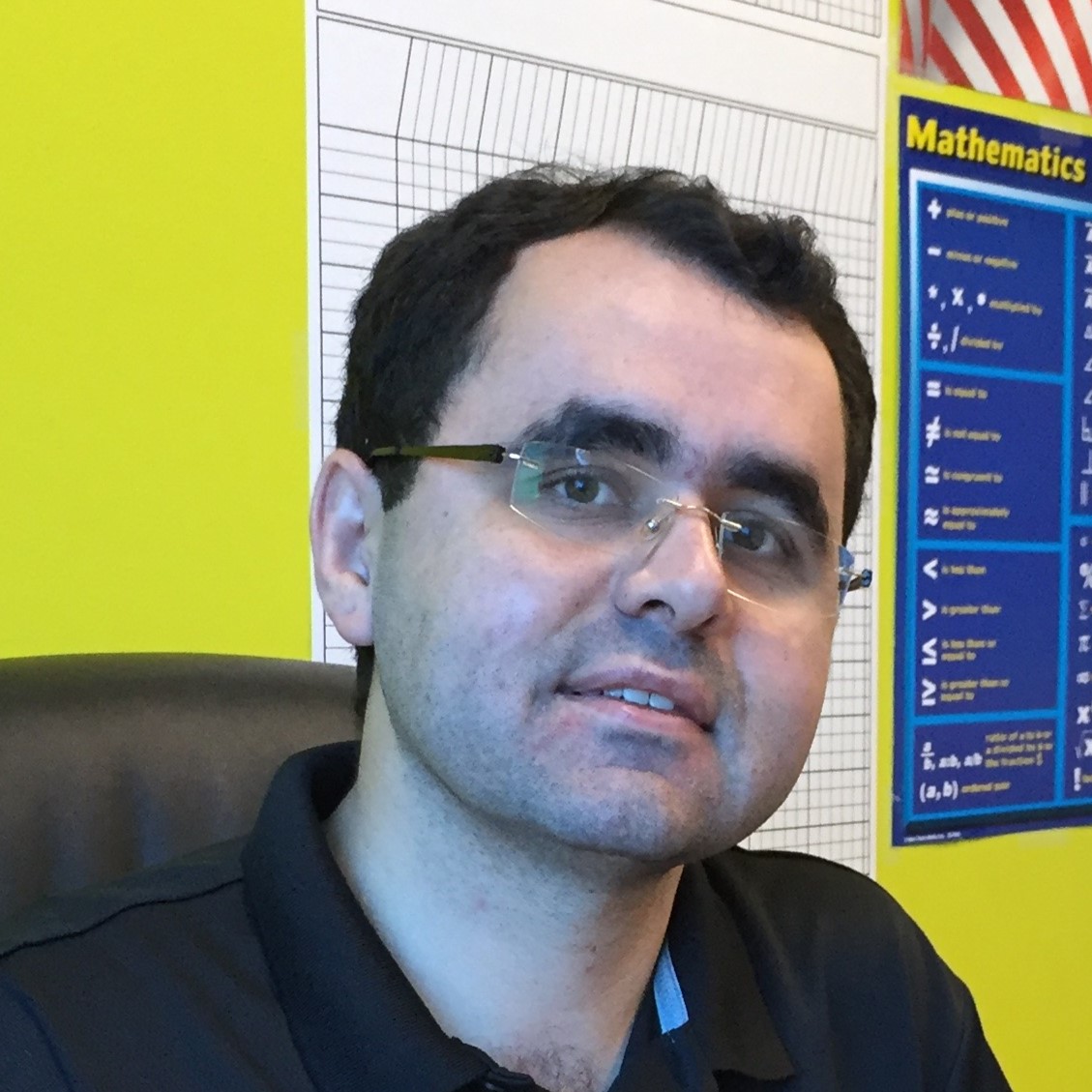 Mr. Oksuz
Mr. Oksuz holds both a Bachelor’s and a Master’s Degree in Mathematics and brings over 12 years of teaching experience focused on high school math classes such as Algebra 1, Algebra 2, Pre-Calculus, AP Calculus, and AP Statistics. Throughout his teaching career, he also coached competitive math teams for Mathcounts, AMC 8, and the AMC 10/12.
In addition, Mr. Oksuz serves as an adjunct professor at a community college, where he continues to share his love for mathematics with students. Whether through mentoring students, contributing to math-related initiatives, or exploring real-world applications of mathematical principles, he is committed to fostering a love of learning that extends well beyond traditional teaching hours.
Class Description
This class will prepare students for the upcoming AP Calculus exam in May. AP Calculus AB/BC is an introductory college-level calculus course. Students cultivate their understanding of differential and integral calculus through engaging with real-world problems represented graphically, numerically, analytically, and verbally and using definitions and theorems to build arguments and justify conclusions as they explore concepts like change, limits, and the analysis of functions.
Homework
Weekly homework will be assigned. It will take approximately 45 – 90 minutes to complete.
Prerequisite
Students should be currently taking AP Calculus AB or BC in school.
Exam Date
Monday, May 11, 2025: 8 AM Local
How AP Calculus AB and AP Calculus BC are different
AP Calculus AB focuses on topics that are taught in the college-equivalent first-semester calculus class. AP Calculus BC focuses on topics covered in both first- and second-semester calculus classes. All topics in the eight units of AP Calculus AB are included in AP Calculus BC.
These are the topics taught in both courses:
- Limits and continuity (Unit 1)
- Differentiation: Definition and fundamental properties (Unit 2)
- Differentiation: Composite, implicit, and inverse functions (Unit 3)
- Contextual applications of differentiation (Unit 4)
- Analytical applications of differentiation (Unit 5)
- Integration and accumulation of change (Unit 6)
- Differential equations (Unit 7)
- Applications of integration (Unit 8)
However, AP Calculus BC contains two additional units (Units 9 and 10), plus some extra topics in Units 6─8. These topics are only taught in AP Calculus BC:
- Additional techniques of integration (Unit 6)
- Euler’s method and logistic models with differential equations (Unit 7)
- Arc length and distance traveled along a smooth curve (Unit 8)
- Parametric equations, polar coordinates, and vector-valued functions (Unit 9)
- Infinite sequences and series (Unit 10)
Section I: Multiple Choice
45 Questions | 1 Hour 45 minutes | 50% of Exam Score
- Part A: 30 questions; 60 minutes (calculator not permitted).
- Part B: 15 questions; 45 minutes (graphing calculator required).
- Questions include algebraic, exponential, logarithmic, trigonometric, and general types of functions.
- Questions include analytical, graphical, tabular, and verbal types of representations.
Section II: Free Response
6 Questions | 1 Hour 30 Minutes | 50% of Exam Score
- Part A: 2 questions; 30 minutes (graphing calculator required).
- Part B: 4 questions; 60 minutes (calculator not permitted).
- Questions include various types of functions and function representations and a roughly equal mix of procedural and conceptual tasks.
- Questions include at least 2 questions that incorporate a real-world context or scenario into the question.
Topics that will be covered by both Calculus AB and BC
Unit 1: Limits and Continuity
- How limits help us to handle change at an instant
- Definition and properties of limits in various representations
- Definitions of continuity of a function at a point and over a domain
- Asymptotes and limits at infinity
- Reasoning using the Squeeze theorem and the Intermediate Value Theorem
Unit 2: Differentiation: Definition and Fundamental Properties
- Defining the derivative of a function at a point and as a function
- Connecting differentiability and continuity
- Determining derivatives for elementary functions
- Applying differentiation rules
Unit 3: Differentiation: Composite, Implicit, and Inverse Functions
- The chain rule for differentiating composite functions
- Implicit differentiation
- Differentiation of general and particular inverse functions
- Determining higher-order derivatives of functions
Unit 4: Contextual Applications of Differentiation
- Identifying relevant mathematical information in verbal representations of real-world problems involving rates of change
- Applying understandings of differentiation to problems involving motion
- Generalizing understandings of motion problems to other situations involving rates of change
- Solving related rates problems
- Local linearity and approximation
- L’Hospital’s rule
Unit 5: Analytical Applications of Differentiation
- Mean Value Theorem and Extreme Value Theorem
- Derivatives and properties of functions
- How to use the first derivative test, second derivative test, and candidates test
- Sketching graphs of functions and their derivatives
- How to solve optimization problems
- Behaviors of Implicit relations
Unit 6: Integration and Accumulation of Change
- Using definite integrals to determine accumulated change over an interval
- Approximating integrals using Riemann Sums
- Accumulation functions, the Fundamental Theorem of Calculus, and definite integrals
- Antiderivatives and indefinite integrals
- Properties of integrals and integration techniques
Unit 7: Differential Equations
- Interpreting verbal descriptions of change as separable differential equations
- Sketching slope fields and families of solution curves
- Solving separable differential equations to find general and particular solutions
- Deriving and applying a model for exponential growth and decay
Unit 8: Applications of Integration
- Determining the average value of a function using definite integrals
- Modeling particle motion
- Solving accumulation problems
- Finding the area between curves
- Determining volume with cross-sections, the disc method, and the washer method
Additional Topics for Calculus BC
Unit 6: Integration and Accumulation of Change
- Additional techniques of integration
Unit 7: Differential Equations
- Euler’s method and logistic models with differential equations
Unit 8: Applications of Integration
- Arc length and distance traveled along a smooth curve
Unit 9: Parametric Equations, Polar Coordinates, and Vector-Valued Functions
- Finding derivatives of parametric functions and vector-valued functions
- Calculating the accumulation of change in length over an interval using a definite integral
- Determining the position of a particle moving in a plane
- Calculating velocity, speed, and acceleration of a particle moving along a curve
- Finding derivatives of functions written in polar coordinates
- Finding the area of regions bounded by polar curves
Unit 10: Infinite Sequences and Series
- Applying limits to understand convergence of infinite series
- Types of series: Geometric, harmonic, and p-series
- A test for divergence and several tests for convergence
- Approximating sums of convergent infinite series and associated error bounds
- Determining the radius and interval of convergence for a series
- Representing a function as a Taylor series or a Maclaurin series on an appropriate interval